
Introduction
Loyalty promotions are special, time-bound programs designed to reward members with additional incentives, such as extra points or coupons beyond the standard benefits of a loyalty program. These are special promotions that run for a short period of time alongside your regular loyalty program.
Beyond simple rewards, loyalty promotions support advanced structures to drive sustained participation:
- Milestones: Reward members for reaching cumulative targets over time, such as spending a total of $500 within a month or completing 10 transactions in 60 days.
- Streaks: Incentivize consistent, consecutive behavior by rewarding members who maintain a continuous series of actions, running five kilometres every day for a week, or purchasing a coffee every day for a month.
These promotions can be tailored to specific customer activities, such as:
- Making a transaction during a holiday period.
- Adding a product to a wishlist on the mobile application.
- Purchasing a featured or limited-time product.
- Making multiple purchases in a month and reaching a purchase goal.
Examples
Fan engagement promotion:
“NASCAR Fantasy” is a loyalty promotion offered by NASCAR, designed to encourage fan engagement with its fantasy racing platform. The primary goal of this promotion is to increase participation in the NASCAR Fantasy Live game.
- The promotion runs during a race week.
- To earn a reward, members must join the NASCAR Fantasy Live game and select a team of drivers they predict will score the most points in that week’s race.
- Members earn 100 points once they submit their list of top drivers.
Streak-based promotion:
"Morning Coffee Run" is a milestone-based promotion by a coffee chain, such as Starbucks, during spring break to encourage daily habits.
- The promotion runs during the spring break (March - April).
- To earn a reward, members must purchase a coffee between 7 AM and 10 AM for five separate days within a single week.
- Members earn 100 points once they achieve the streak.
Key features
-
Versatile promotion types: Design loyalty promotions for various member activities, such as making a purchase or adding a product to their wishlist.
-
Create milestones to reward cumulative targets, such as spending $500 a month.
-
Create streaks to incentivize consecutive actions, such as logging in for 3 weeks in a row.
-
Define qualifying conditions using dropdown-based rule writing.
-
Diverse reward options: Incentivize members with a wide range of benefits, such as bonus points, limited-time tier upgrades, exclusive badges, or coupons.
-
Role-based access control (maker-checker workflow): Access features based on assigned user permissions, while ensuring quality and security through a role-based approval process that separates promotion creation from activation.
-
Zero-downtime live editing: Update active promotions seamlessly, creating a new draft version while the current one continues to run without interruption.
-
Comprehensive lifecycle management: Maintain full control over every stage of your promotion, from the initial draft to live activation, temporary pausing, and final sunset.
-
Liability split: Clearly divide and track who pays for each reward between you and your partners, so everyone knows exactly how much cost they are responsible for in a coalition or partnership promotion.
-
Custom attribute tagging: Enhance internal reporting and analytics by attaching custom metadata such as budget, campaign objectives, and target segment to search, filter, and analyze performance in reports.
What is the difference between a loyalty program and a loyalty promotion?
Loyalty programs and loyalty promotions both reward members, but they serve different strategic purposes. A loyalty program is the foundational, ongoing, long-term strategy by any brand for rewarding members, whereas a loyalty promotion is a short-term strategy run by brands that offers additional incentives or benefits to members.
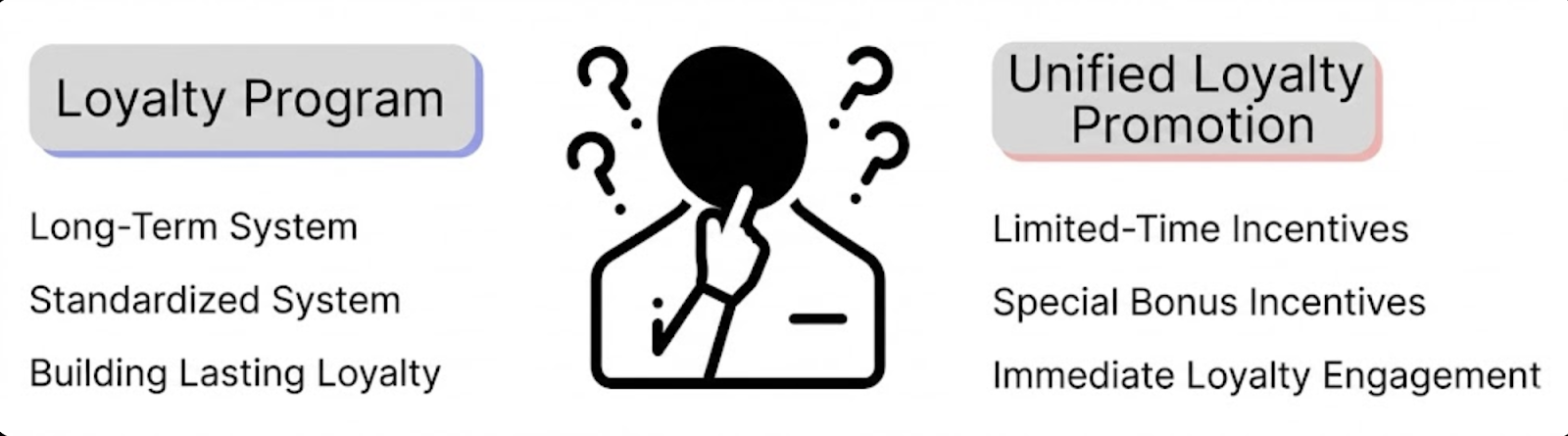
The table below elaborates on the key differences between loyalty programs and promotions:
| Feature | Loyalty Program | Loyalty Promotion |
|---|---|---|
| Duration | Long-term system | Temporary incentives |
| Reward Type | Standard incentives | Extra incentives |
| Main Goal | Lasting loyalty | Immediate engagement |
Lifecycle of a loyalty promotion
Every loyalty promotion you create moves through a lifecycle, represented by a status. This status tells you exactly where the promotion is in its journey, from the initial draft to a live promotion, and finally to its retirement. Understanding each status is essential for managing your loyalty promotion effectively, knowing what actions are possible at each stage.
A loyalty promotion can be in one of the following statuses:
| Status | Description |
|---|---|
| Draft | Represents the initial state of a new promotion. You can edit it while it's inactive. Members can't see promotions in this state, and the system doesn't evaluate them. The primary actions are to edit the draft or send it for approval. |
| Awaiting approval | Represents a promotion submitted for review and pending action from a checker. It cannot be edited by the checker, which makes sure the reviewer sees a consistent version. A maker can revoke the submission to return it to the draft state for further changes. |
| Upcoming | Represents an approved promotion that hasn’t reached its scheduled start date. The configuration is locked, and the promotion isn’t being evaluated for member activities. |
| Live | Represents an approved promotion currently during its scheduled active period. It is actively evaluated against member activities to grant rewards. A maker can pause the promotion or edit it to create a new draft, and an admin can stop it. |
| Paused | Represents a live promotion temporarily deactivated by a maker or an admin. While paused, all processing stops: members can't enrol or opt in, and activities are not evaluated for rewards. It can be resumed anytime to return to the live state. |
| Ended | Represents an approved promotion that is past its scheduled end date. While the promotion stops processing new member actions, it continues to evaluate previous activities that occurred during the active period. |
| Stopped | Represents a promotion permanently and irreversibly deactivated by an admin. It can no longer be edited, resumed, or evaluated. This status is used to formally archive a promotion and make sure it can't be accidentally reactivated. |
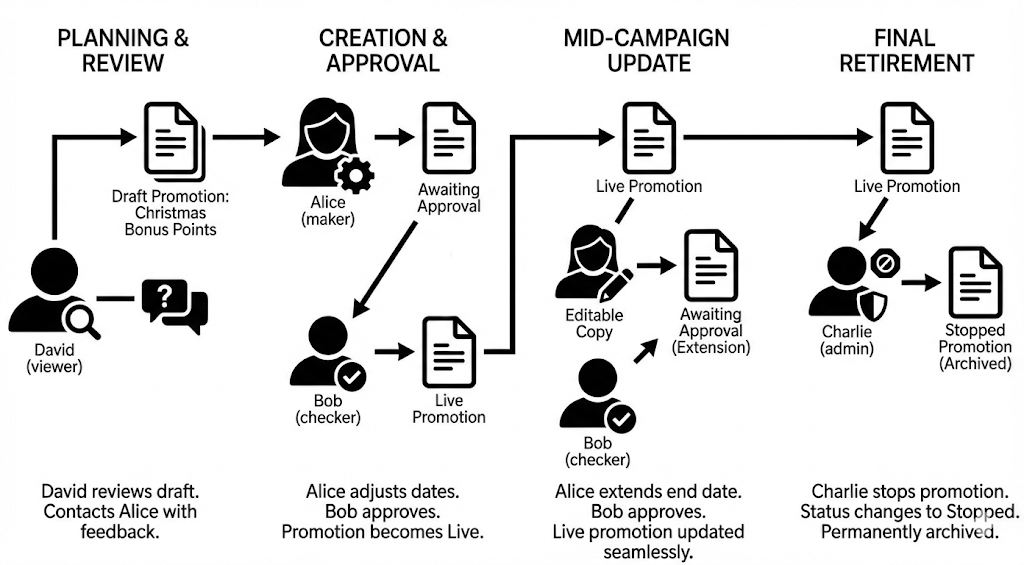
Use case: Lifecycle of the "Christmas Bonus Points" promotion
Roles involved:
David (viewer): Regional Marketing Manager
Alice (maker): Loyalty Program Specialist
Bob (checker): Head of Loyalty
Charlie (admin): System Administrator
Planning and review (the viewer's role)
The marketing team has a plan for a new "Christmas Bonus Points" promotion, which has been saved as a draft for visibility.
- David (viewer) logs in to review the loyalty promotion. He can see the draft of the "Christmas Bonus Points" promotion, but has no permissions to edit it.
- He notices the proposed start date conflicts with another event. Because he cannot make changes himself, he contacts the promotion's owner, Alice, with his feedback.
- Result: The viewer role allows key stakeholders like David to stay informed and provide essential feedback without having the ability to make potentially disruptive changes to the loyalty promotion.
Creation and initial approval (maker & checker)
Alice receives the feedback and prepares the promotion for launch.
- Alice (maker) opens the draft, adjusts the start date based on David's feedback, and verifies all other rules are correct.
- She selects Send for Approval. The promotion status changes to Awaiting Approval.
- Bob (checker) gets a notification to review the submission. He examines the promotion's details, sees that the dates are now correct, and is satisfied with the configuration. He clicks Approve.
- Result: The promotion is now live and will become active on its scheduled start date.
Mid-campaign update (maker & checker)
The promotion is a success, and the team decides to extend it by one week.
- Alice (maker) finds the live promotion and selects Edit Promotion. This creates a separate, editable copy, while the original continues to run.
- She changes the end date in the new draft and selects Send for Approval.
- Bob (checker) reviews the single change, the extended end date, and selects Approve.
- Result: The new end date is merged into the live promotion, seamlessly extending the promotion without any downtime.
Final retirement (admin's role)
The extended promotion period is now over. To formally close it out and ensure it cannot be accidentally reactivated, a final action is required.
- Charlie (admin) logs in to perform a system cleanup at the end of the quarter. He filters for all promotions that have ended.
- He selects the "Christmas Bonus Points" promotion and selects the Stop button. This is a permanent, irreversible action that only admins can perform.
- Result: The promotion's status changes to Stopped. It is now permanently archived and can no longer be edited, resumed, or evaluated.
How can I enable and access loyalty promotions?
The loyalty promotions UI is enabled by default for all organizations created after January 2026. Once enabled, users can access features based on their assigned permissions. For organizations with both old loyalty promotions and new promotion UI, use the old UI to view and manage ongoing loyalty promotions created in that system, and the new UI to create new promotions.
The loyalty promotions UI is not enabled by default for all organizations created before January 2026. To enable the new promotions UI, raise a JIRA ticket to the Capillary product support team.
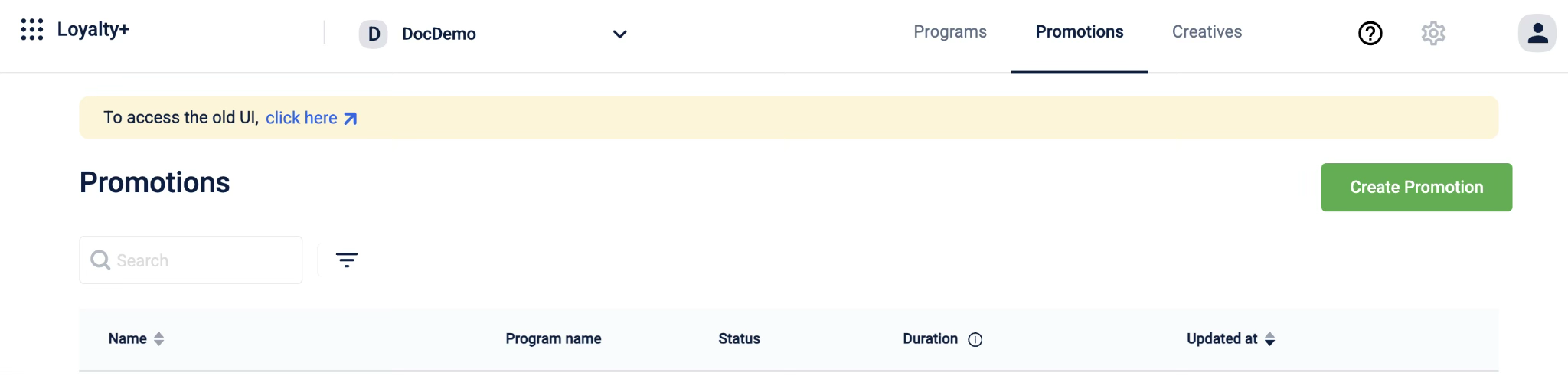
Accessing loyalty promotions from the UI
Once you have access to the loyalty promotions UI, based on your permissions, you will be able to access various features such as creating, viewing, or approving loyalty promotions. If you have the old loyalty promotions, you can
Accessing from the old UI
Once you have access to the loyalty promotions UI, you can navigate to the loyalty promotions UI from the old UI page.
To navigate to the listing page, follow these steps:
-
Select the Promotions tab from the Loyalty+ program page.
-
Select click here from the message prompt to access the loyalty promotions UI.
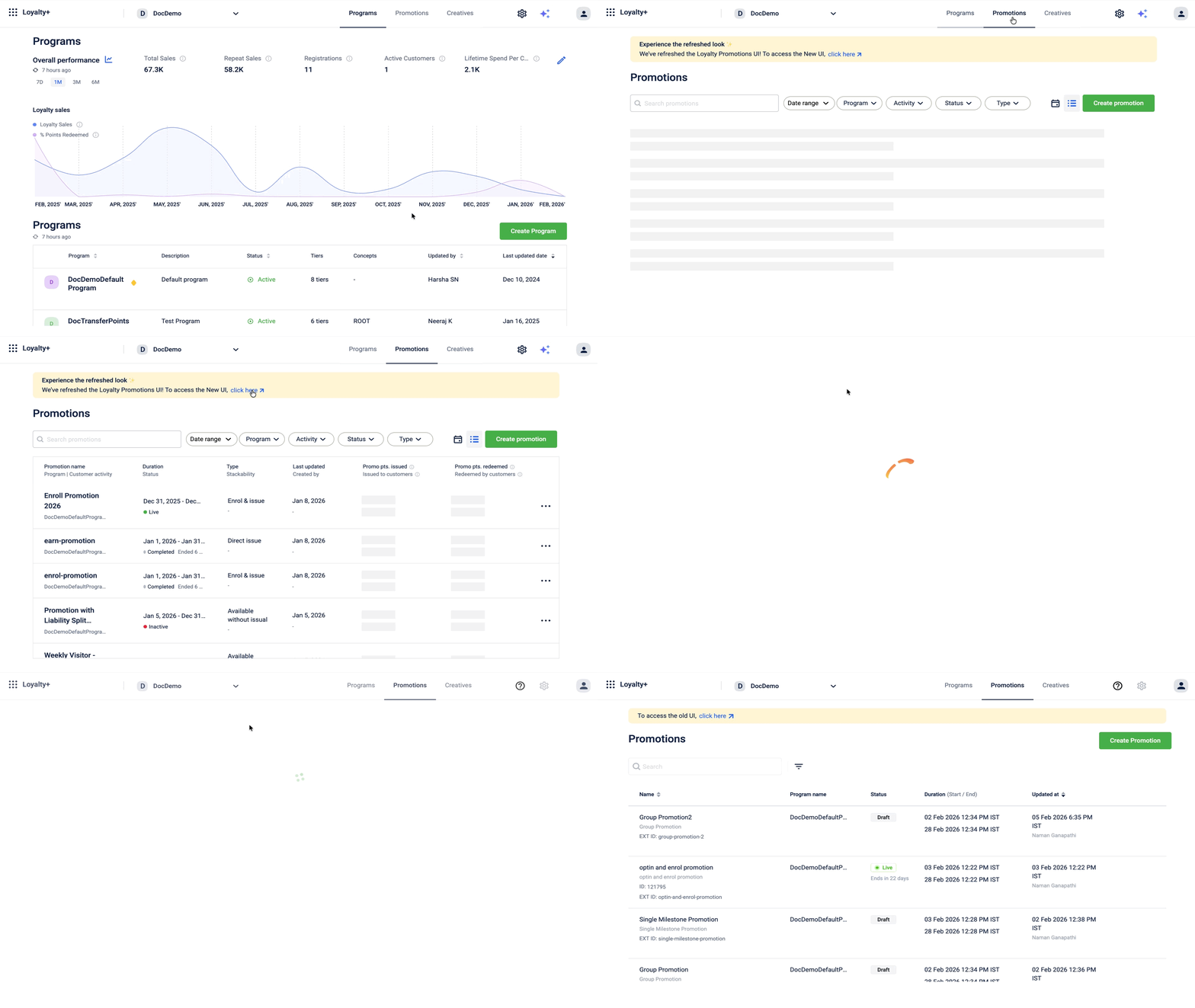
Accessing from Loyalty+
Once you have access to the loyalty promotions UI, you can navigate to the loyalty promotions UI from Loyalty+. Loyalty promotions UI is enabled by default for all organizations created after January 2026.
To access loyalty promotions, select the Promotions tab from the Loyalty+ program page.

Viewing old loyalty promotions
You can view and manage live and upcoming loyalty promotions created on the old UI from the loyalty promotions listing page.
To view loyalty promotions created on the old UI, select Promotions via new UI from the drop-down menu.

Role-based access control (Maker-Checker)
The Maker-Checker role-based access control (RBAC) workflow is a fundamental security and quality control process for managing loyalty promotions. This system separates the responsibility of creating a promotion (the maker) from the responsibility of approving it (the checker). The primary goal of this workflow is to add a crucial layer of review to the promotion configuration process
Roles and permissions
There are four types of roles available. Each role has a set of permissions that determine what you can see and do. The following roles are available:
| Role | Permission Set | Key Responsibility | Core Permissions |
|---|---|---|---|
| Viewer | Loyalty+ Promotions Viewer | Monitor Promotions | View all loyalty promotions created for the organization. |
| Maker | Loyalty+ Promotions Editor | Create & Edit Promotions |
|
| Checker | Loyalty+ Promotions Approver | Approve & Reject Changes |
|
| Admin | Loyalty+ Promotions Admin | Full Control |
|
Refer to the documentation on User Management for more information on providing access to users.
Examples
The following examples show how loyalty promotions can be designed across verticals:
Example 1: Weekly quiz promotion
Vertical: Sports and entertainment
Use Case: A sports brand wants to reward engagement by offering 100 reward points to customers in the United States and Canada who complete a "Weekly Race Quiz." The reward is triggered by a specific behavioral event (PlayRaceQuiz_2025).
Outcome: Drives consistent weekly app engagement from target demographics in North America by incentivizing quiz participation.
Example 2: Bonus points based on milestone Range
Vertical: Retail
Use Case: A retail brand wants to encourage higher spending among Gold-tier members. They offer 10% of the milestone achievement value in points when a customer spends $1000 across up to five transactions, excluding gift card purchases and specific SKUs.
Outcome: Increases purchase frequency and basket size among top-tier customers while ensuring low-margin items like gift cards do not accrue bonus liability.
Vertical: Automotive
Use Case: An automotive brand wants to boost sales of "Sheetz" line items and increase data collection. Customers providing data consent earn 10% points on these items. Additionally, customers swiping their membership card receive a bonus coupon.
Outcome: Incentivizes specific product sales and data sharing consent, while driving habit formation around using the physical membership card.
Example 4: Scratch and win coupons
Vertical: Conglomerate
Use Case: A brand wants to gamify the customer experience with a "Scratch and Win" sweepstakes. Customers who spent min $50 in the last three months can opt-in to win discount coupons or a grand prize of 5000 points via a behavioral event (scratching a card).
Outcome: Increases customer interaction and excitement through gamification, rewards recent high-value shoppers, and creates urgency with enrolment limits.
Example 5: Double points on Thanksgiving reservations
Vertical: Hospitality
Outcome: Secures revenue in advance of the holiday season by rewarding early commitment and specific booking behaviors.
Updated 5 months ago