
Core Concepts
Objective
A promotion's objective is its primary business goal, such as driving a specific member behavior or distributing a direct reward. This objective is fundamentally defined by selecting a promotion type, which determines the core mechanism by which a member becomes eligible for and receives the benefits of the loyalty promotion. Selecting the appropriate type is essential for aligning the promotion's structure with its intended goal.
There are two types of loyalty promotions:
| Promotion Type | Description | Example |
|---|---|---|
| Activity-based promotion | Members earn this promotion by completing a predefined activity, such as making a transaction, redeeming points, or visiting a store. | A retailer wants to encourage new members to make their first purchase. They set up a promotion in which members receive a 10% discount coupon only after completing their first transaction of $20 or more. |
| Broadcast promotions | Members receive this promotion directly through communication channels, such as email or SMS, and earn incentives without completing any prerequisite activity. | At the start of a festive season, a brand directly issues a $5 voucher to all 'Platinum Tier' members via email as a thank you for their continued engagement, which they can use on their next visit. |
Eligibility
Eligibility defines who can participate in the promotion. This is managed through a two-step process: enrolment determines the target audience, while the optional opt-in requires members to consciously signal their interest.
Enrolment: This is the first step that defines the broad audience for the promotion. You can target all members of your loyalty program or target specific members based on predefined audience groups, their completion of a qualifying activity, or an external trigger via the enrol API call.

Opt-in: This is an optional second step that requires an enrolled member to perform an explicit action to actively participate. This ensures that only engaged members who have consciously chosen to join can earn rewards. An opt-in is triggered based on the completion of a qualifying activity or an external trigger via the opt-in API call.

Duration
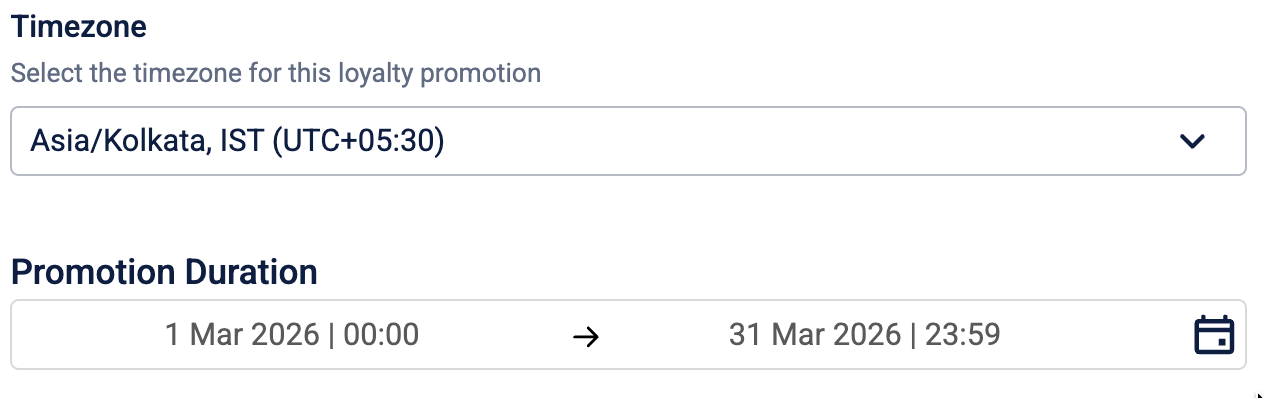
The duration defines the specific timeframe during which a promotion is active. Here, you can define the start and end dates and times for the loyalty promotion. You can also define a timezone for the duration.
- Timezone Management: Promotions operate in a specified timezone to ensure accuracy across different regions. All date and time configurations are handled in the ISO 8601 standard, which includes a timezone offset. Each promotion is also tagged with a timezone name, for example,
Asia/New Delhito maintain a clear record of its intended operational timezone. - Default Timing: If you select a start and end date without specifying a time, the promotion will run for the full duration of those days, defaulting to a start time of 00:00 and an end time of 23:59 in the chosen timezone.
Earning criteria
Earning criteria define the specific behaviors required to earn a loyalty promotion's reward. This involves selecting an activity type to structure the goal, such as a one-time single action or a cumulative milestone, identifying the member action to track, such as making a transaction, and applying qualifying conditions to ensure rewards are granted only for exact behaviors.
Member activities
Activities define the core logic of a loyalty promotion's earning criteria. They determine how a member's actions result in rewards and serve as the foundation for driving specific behaviors, such as repeat purchases or increased engagement.
A loyalty promotion activity can be one of three types:
- Single: Rewards a one-time action, such as purchasing a specific featured product.
- Milestone: Rewards a cumulative target reached over time, such as spending a total of $200 across multiple transactions.
- Streak: Rewards consistent, consecutive behavior, such as making a transaction once a week for three consecutive weeks.
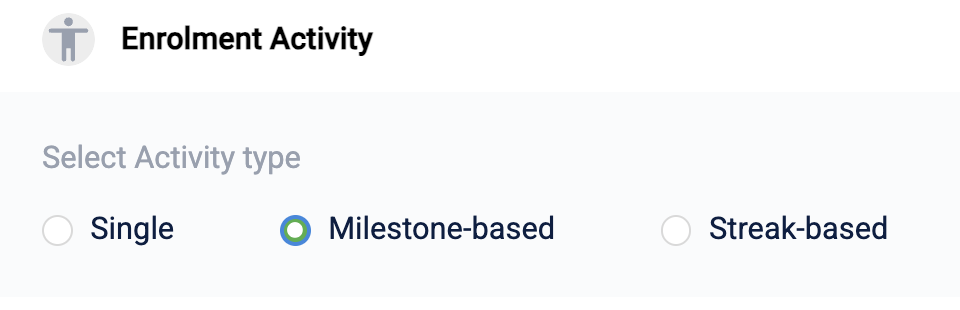
The following table explains the available types of activities in detail:
| Activity type | Description | Example |
|---|---|---|
| Single | Reward a member for performing a one-time customer activity. This is used for straightforward actions that do not require tracking progress over time. | A member receives 50 bonus points after purchasing a specific featured product for the first time during a loyalty promotion. |
| Milestone-based | Rewards a member for reaching a cumulative target within a defined period or cycle. It tracks progress toward a specific goal across multiple interactions. You can also define the cycle or period for the milestone-based promotion. | A member earns 500 bonus points after spending a total of $200 or more across any number of transactions during a loyalty promotion. |
| Streak-based | Rewards a member for completing a series of consecutive actions over a specified period. This requires members to maintain continuous behavior to earn the reward. | A member earns a special discount coupon for making a purchase of $50 or more once a week for three consecutive weeks. |
Cycles in milestone-based promotions
Cycles are the mechanism that transforms a single, one-time milestone into a recurring challenge. They encourage consistent, repeated member behavior by defining a reset period for a goal. Without cycles, a milestone like "Spend $100" is a goal a member achieves only once. With a monthly cycle, it becomes an ongoing challenge: "Spend $100 each month to earn a reward."
The core of a cycle is its reset period. This defines the time window (such as daily, weekly, or monthly) during which a member's progress is tracked. At the end of each period, their progress resets to zero, and they must restart the challenge. Also, the cycle start date determines when the challenge begins for a member. It can be configured to start uniformly for all participants (for example, on the promotion start date) or to begin personally for each member only when they perform their first qualifying activity.
The following table shows the maximum number of possible cycles for each time window:
| Time window | Maximum possible value |
|---|---|
| Daily | 730 days (2 years) |
| Weekly | 104 weeks (2 years) |
| Monthly | 60 months (5 years) |
| Yearly | 10 years |
| Custom | 104 weeks (2 years) |
Note:When different actions for cycles are enabled, the maximum number of cycles is capped at 24, assuming the highest possible frequency (monthly) over a 2-year window.
Member actions
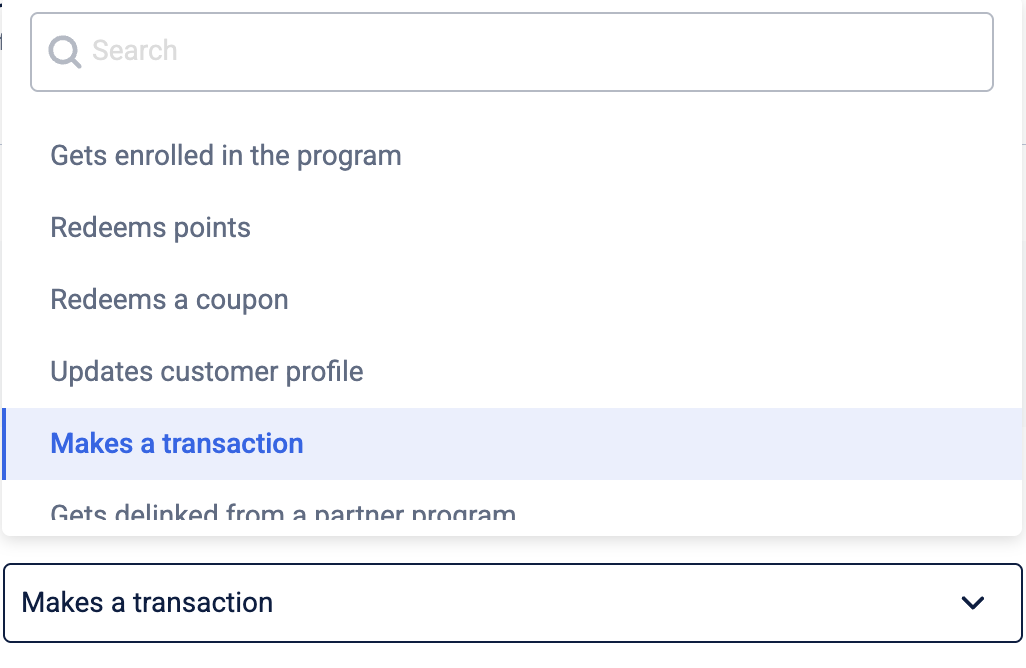
The member action is a specific event or behavior that is the trigger for a promotion's earning criteria. This selection is a key part of the rule, defining the primary member interaction to monitor. It determines the nature of the promotion, whether it rewards a transactional behavior like making a purchase, an engagement activity like updating a profile, a loyalty interaction such as redeeming points, or any other custom behavioral event. Refer to the document on Member Actions for more details.
Qualifying conditions and attributes
Qualifying conditions are the specific rules that an activity must meet to be considered valid for a loyalty promotion. While an activity defines a general member action, such as "making a transaction", qualifying conditions provide the necessary precision. This is achieved by adding criteria based on specific attributes related to the member, user groups, purchase details, payment modes, or other event data. By using these conditions, you can ensure that rewards are granted only for the exact behaviors you intend to target. Refer to the document on Qualifying Conditions and Attributes for more details.

Incentives
An incentive is what a member receives upon completing a qualifying action. These are configured as brand actions. Rewards can range from issuing loyalty points and alternate currencies to managing a member's tier status. The configuration allows for precise control over the reward value, its expiry, and the timing of its issuance.
Refer to the section on Actions for loyalty promotions for more details.
Communication
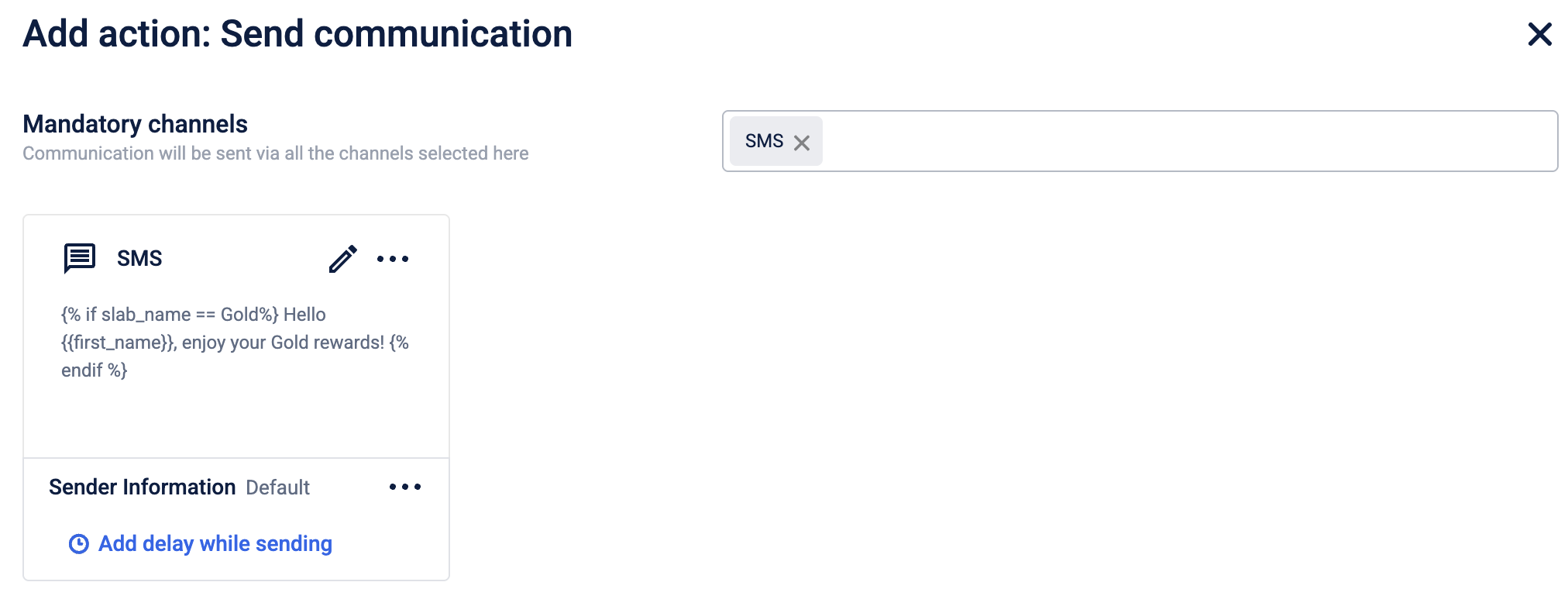
Communications can be configured to automatically trigger at key moments in the member's promotion journey. This allows you to send targeted messages, such as via email or SMS, to keep members informed and engaged. Messages can be sent upon successful enrolment, successful opt-in, or as part of a reward action itself. You can send a communication to members using the Send Communication action or when configuring an action that supports communications.
Reporting and tracking
The analytics dashboard provides a comprehensive view of your promotion's performance, allowing you to track its impact and effectiveness. Once a loyalty promotion is active, it displays key metrics such as member enrolment, opt-in rates, points issued, and redemption statistics in a single, consolidated view.
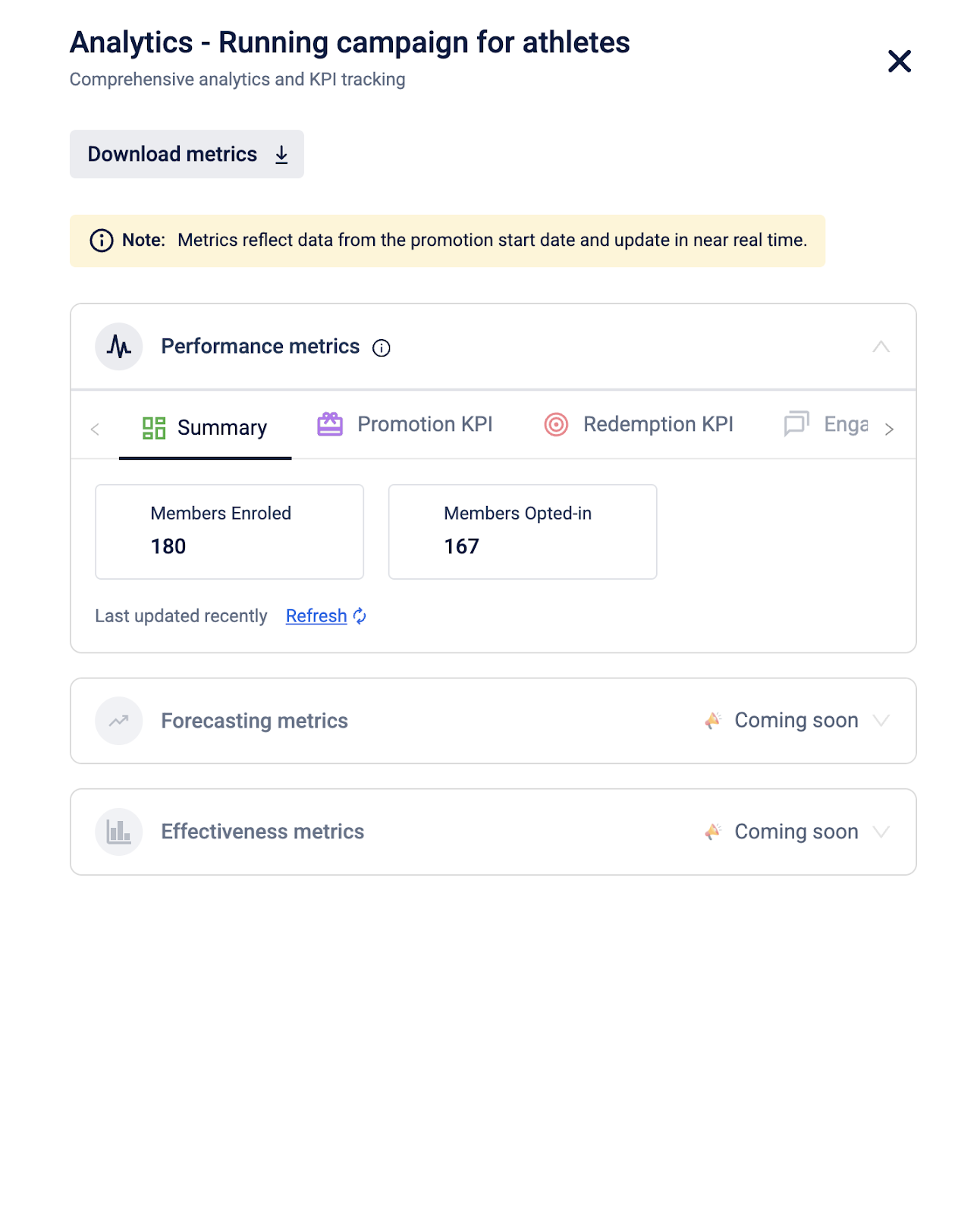
The following table lists the analytics data available for a loyalty promotion:
| Metric Category | Data Parameter | Description |
|---|---|---|
| Summary | Members enrolled | The total number of members who have successfully met the enrolment criteria and are eligible to participate in the promotion. |
| Members Opted-in | The number of eligible members who have explicitly performed an opt-in action to join the promotion (applicable only if opt-in is configured). | |
| Promotion KPI | Points issued | The total sum of loyalty points awarded to members through this specific promotion. |
| Coupons issued | The total count of coupons issued to members as rewards for completing the promotion's activities. | |
| Redemption KPI | Points redeemed | The total number of points earned from this promotion that members have subsequently used or burned for rewards. |
Refer to the section on Reporting for for more details on reports within Insights+.
Limits
Participation and reward limits are essential controls that set the boundaries for a loyalty promotion, ensuring it remains effective and financially viable. They are divided into two main categories: those that manage member participation and those that limit the rewards.
Participation limits govern the promotion's lifecycle by defining who is eligible to join, how many times they can enrol, and the total number of participants allowed. In contrast, reward limits control the benefits themselves, limiting the total points a member can earn or the number of times a qualifying activity can be rewarded. Together, these limits are crucial for managing the promotion's budget, preventing reward abuse, and strategically creating a sense of exclusivity or urgency. Refer to the document on Loyalty Promotion Limits for more details.

Updated 1 day ago